Yes, I Talk About Mental Health. No, I’m Not Falling Apart

At the gym today, my trainer asked me how I was doing mentally. Not physically. Mentally. And I loved that. I didn’t expect it, but it felt like a breath of fresh air — the kind that doesn’t make your knees buckle mid-squat. We talk about sore legs and stiff backs and vitamins and sleep, so why not talk about our mood? Our mental state?

Here’s the funny thing, though: ever since I started sharing a little more about the behind-the-scenes stuff — stress, feeling overwhelmed, navigating hard days — people keep asking if I’m okay.

And the answer is: Yes. I’m good. Really.
There is no need to tiptoe around me like I’m one strong breeze away from a meltdown. I’m the same ol’ Sonja — I’ve just let you see a few of my “insides.”

Last week, I missed my blog post because I was sick. Not just sniffly, but down-for-the-count sick. And it’s so easy to fall out of a routine when life throws a wrench (or a virus) at you. I wasn’t even sure I wanted to be honest with myself, much less with you… or with Jeffery. I went into survival mode. And that counts too. There’s value in just getting through. But eventually, I wanted more. I missed the depth. I told Jeffery how I felt. And — surprise, surprise — he had something wise to say.

Jeffery’s Note:


When you train for something physical — like your upcoming hike — you build strength by showing up even when you’re tired. Mental health works the same way. The goal isn’t perfection or endless positivity. The goal is presence. Awareness. Naming what’s real without letting it define you. Talking about hard things isn’t a sign that something’s wrong. It’s a sign you’ve stopped hiding. That’s not falling apart — that’s putting yourself back together on purpose.

I share the “inside stuff” not because I’m coming undone, but because I spent too much of my life pretending I wasn’t. I’d rather be honest. I’d rather be real. It helps me. And I think — I hope — it helps other people too.

For years, I compared my insides to other people’s outsides. I judged myself for feeling too much or not being able to “just deal.” But now? I want to be the kind of person who can talk about a bruised heart just as easily as a bruised ankle. I want the hard parts to be just another part of the story — not the thing that silences it.

Mental health is part of health. Talking about it doesn’t mean something’s broken. Sometimes it just means something’s working.

Tune in next week to find out what muscles are sore, what wisdom Jeffery drops, and whether or not I made it to Zumba. Spoiler alert: it’s a cliffhanger.
Wanted, Needed, and Running on Jellybeans

“If we don’t feel wanted, we will make ourselves feel needed.”

I was doom scrolling on TikTok when I heard this, and I immediately felt called out and exposed. How can one sentence describe me so well?

I have a long history of being a helper. In my obituary, I imagine it will say, “She was always doing for others” and “She would give you the shirt off her back.” And while that sounds noble on paper, in reality it often means I’ve skipped lunch, let my laundry pile into an angry and intimidating mountain, and cried in the car on the way to rescue someone else—while quietly drowning myself.

I ask myself, why?
Why is it so hard to take care of me?

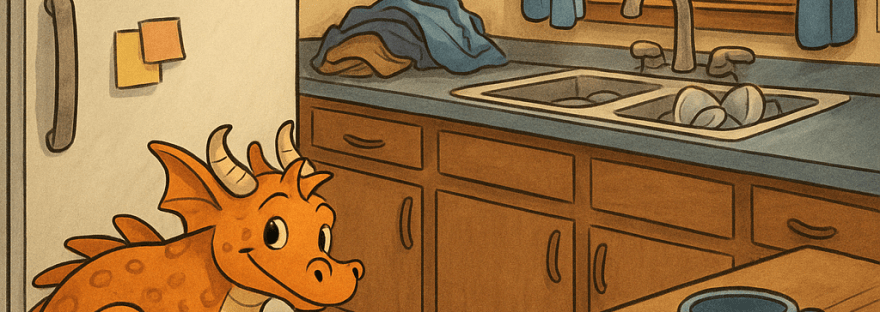
Have you ever put off a chore because it just feels too hard? Like the dread feeds the task until it’s no longer “doing the dishes”—it’s battling through a dark and creepy castle guarded by a fierce dragon.

So maybe the answer to the “why” is… that it is hard. And helping others keeps me safe from facing that dragon in my own house.

But here’s the thing: the dragon isn’t real.

Jeffery says a chore is just a task—not a fire-breathing monster. But try telling that to my anxiety, which has already spun every possible failure scenario in full cinematic detail.

So instead of facing the laundry dragon, I pack up my emotional sword and go conquer someone else’s beast. I offer rides, cook meals, and clean closets that don’t belong to me. I stay busy. I stay needed. And in the process, I somehow feel… wanted.

But here’s the twist: when I pour all my energy into being there for everyone else, there’s nothing left in the tank for me. I’ll spend hours helping a friend clean their garage, but come home too exhausted to cook for myself. So I stand in the kitchen—tired, depleted, and hungry—and reach for whatever’s easiest. And sometimes, that’s jellybeans. I’m in my own mess surrounded by my own neglected needs and I don’t have the energy to feed myself like a person with actual bones and organs.

I joke, but it’s a pattern I’m working on breaking. Helping others is beautiful—sacred, even. But when it comes at the expense of my own well-being, it stops being service and starts being self-abandonment.

So, here’s what I’m learning:

If I don’t want my legacy to be “she helped everyone but herself,” I have to start treating myself like someone worth helping. Even if that help looks like doing the dishes. Or cooking a real meal. Or, at the very least, eating something with vitamins before I dive headfirst into the jellybean bag.

This week, I’m trying to do one helpful thing—for me. What will I choose? Come by next week to see.

📝 From the Desk of Jeffery

Sonja, I say this with affection and just a hint of concern:

Jellybeans are not dinner.
They’re not vegetables.
And no, they don’t count as a “side dish” just because you eat them out of a bowl.

But I get it. You’re tired. Life is loud. And sometimes a sugar-fueled spiral is easier than facing the dishes.

Still, you deserve real food. Real rest. Real care.

So take a breath. Feed yourself something with a protein source.

And remember: being needed is lovely, but being well is better.

(P.S. I’m proud of you. Even when you’re eating jellybeans in your pajamas standing over the sink.)